Most families do not fall apart in one dramatic moment. They drift. They fray at the edges. They get tired. And eventually, what used to feel normal starts to feel heavy.
That is why learning to strategically push the restart button is not weakness. It is wisdom.
A reset is not you quitting on your people. It is you refusing to let chaos be the manager of your home.
The truth is, life does not announce transitions with a calendar invite. Sometimes it is sudden, a job shift, a diagnosis, a move, a betrayal, a new baby, a teenager entering a new stage. Other times it creeps in quietly until you realize the rhythm that held you together no longer fits.
And when rhythm breaks, relationships feel it first.
Why Stability Matters More Than You Think
Stability is not boring. Stability is safety.
It is the everyday nuances that keep a family emotionally regulated.
Who makes dinner and when
How mornings start
Who picks up the kids
How bills get paid
How conflict gets resolved
How affection gets expressed
How you recover after a hard day
These “small” things are actually the scaffolding of trust. When the scaffolding gets shaky, people start compensating in unhealthy ways.
• One person overfunctions and carries everything
• Another checks out emotionally
• Kids act out because the emotional temperature changes
• Couples begin living parallel lives instead of integrated lives
Stability does not mean nothing changes. It means the bond stays steady while everything else adjusts.
As Scripture reminds us, “A cord of three strands is not quickly broken.” Ecclesiastes 4:12. That cord is built in ordinary days, not only in crisis.
The Variables That Break Rhythm and Fracture Relationships
Families are constantly dealing with variables that can break, fracture, tear, or split connection, such as:
• Financial pressure and inconsistent work schedules
• Health challenges, mental health strain, addiction, burnout
• Grief, loss, and unresolved trauma
• Parenting stress and shifting child development stages
• Unspoken resentment, unmet needs, or ongoing conflict patterns
• Poor communication and assumptions replacing clarity
• Major life transitions like relocation, custody changes, or blended family dynamics
When these pressures hit, people often try one of two extremes.
One extreme is pretending nothing happened.
The other extreme is blowing everything up.
A strategic reset is the middle way. It is the ability to pause, get honest, and rebuild order without losing forward movement.
The Variables That Break Rhythm and Fracture Relationships
Families are constantly dealing with variables that can break, fracture, tear, or split connection, such as:
• Financial pressure and inconsistent work schedules
• Health challenges, mental health strain, addiction, burnout
• Grief, loss, and unresolved trauma
• Parenting stress and shifting child development stages
• Unspoken resentment, unmet needs, or ongoing conflict patterns
• Poor communication and assumptions replacing clarity
• Major life transitions like relocation, custody changes, or blended family dynamics
When these pressures hit, people often try one of two extremes.
One extreme is pretending nothing happened.
The other extreme is blowing everything up.
A strategic reset is the middle way. It is the ability to pause, get honest, and rebuild order without losing forward movement.
How to Press Restart Without Losing Momentum
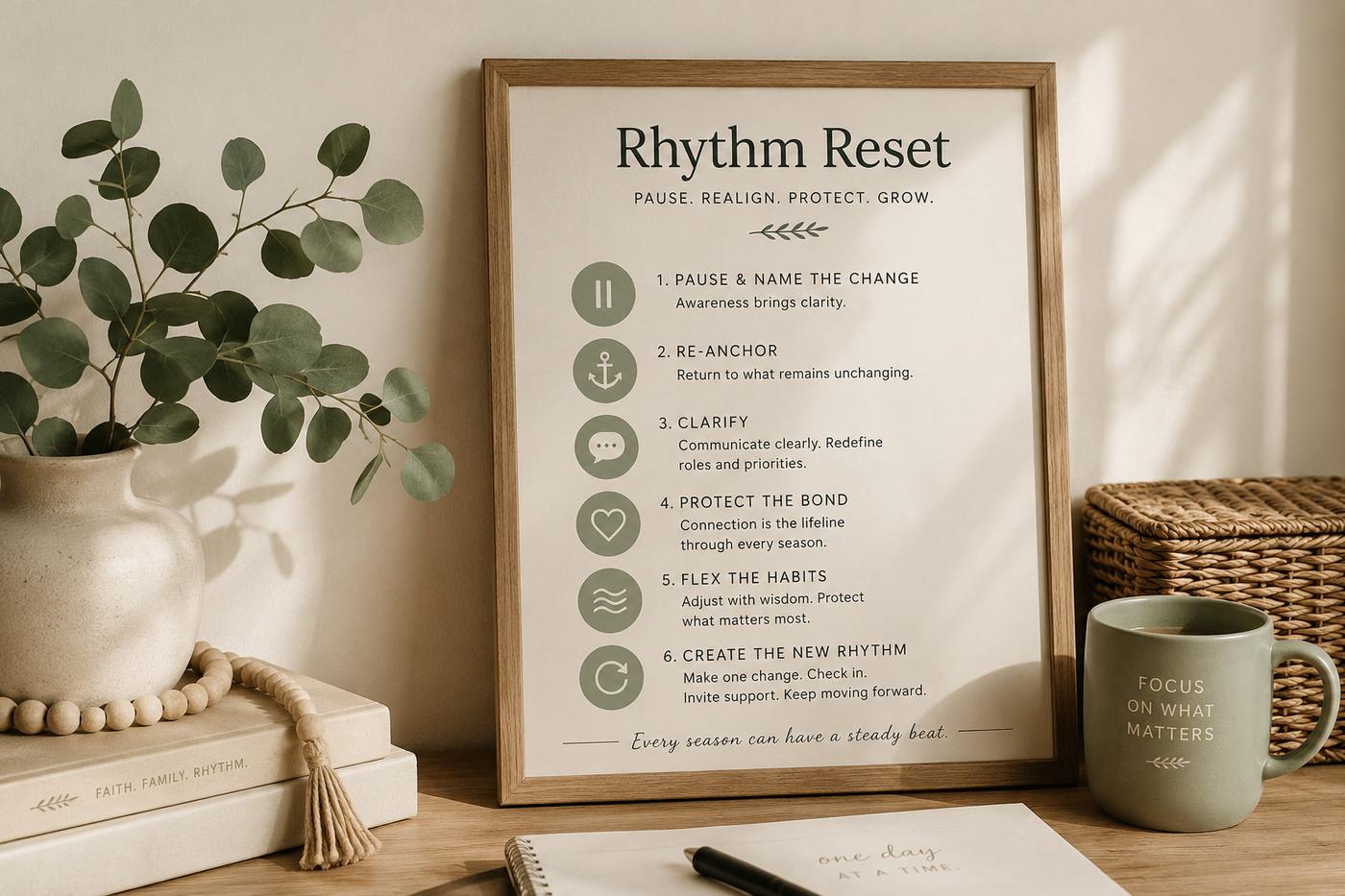
A real reset is not a vague promise like “we need to do better.” It is a repeatable process you can come back to anytime change hits.
1. Pause and Name the Change
The first step is not fixing. It is noticing.
Ask: What just shifted in our world
Be concrete. Not “life is hard” but “my work schedule changed” or “we stopped having dinner together” or “we have been arguing about money weekly.”
Then honor what you feel. Change brings fear, relief, grief, excitement, or all of it at once. Those emotions are not enemies. They are signposts telling you what matters.
2. Re Anchor to What Stays Fixed
Every reset needs a foundation.
In seasons of change, identify what remains unchanging: your faith, your values, your covenant promises, your shared vision as a family.
The guide compares your life to a song. The tempo may change, but the melody remains.
That is the heart of stability. Not rigid control, but anchored identity.
3. Clarify Expectations with Direct Communication
Assumptions are the enemy of adaptation.
When life shifts, roles and expectations must be spoken out loud. Otherwise confusion turns into chaos, and chaos becomes conflict.
This is also where “good enough” becomes holy. Perfectionism is a luxury of stable seasons. In transition, good enough is not settling. It is wisdom.
4. Protect the Bond on Purpose
When rhythm changes, emotional distance can grow fast. One person adapts one way, the other adapts differently, and suddenly you are roommates, not partners.
This is why connection rituals matter.
Choose one ritual of connection for this season:
• a five minute check in before bed
• a weekly walk
• a shared meal with phones away
• a prayer moment in the morning
• a longer hug when you part
The guide puts it plainly: even if the tempo changes, the beat of connection must remain steady.
5. Flex the Habits, Do Not Abandon Them
Your old routines were designed for a life that no longer exists. That does not mean your values disappeared. It means your habits need to bend.
A powerful reset move is choosing one healthy habit to protect no matter what.
Examples:
• seven hours of sleep
• daily movement
• a shared meal
• a short devotional or prayer
• a weekly family meeting
Then flex everything else thoughtfully. Less often, shorter duration, different time of day. Flexing is not failure. It is wise adaptation.
6. Build the New Rhythm with One Concrete Change
Resets become real when they become specific.
Not “we will communicate better,” but “we will do a 10 minute check in after dinner Tuesday and Thursday.”
Then set accountability: pick a date one or two weeks out to evaluate what is working and what needs tweaking.
A Reset That Maintains Order and Growth
The goal is not perfection. It is progress.
Order is not about controlling every variable. Order is about having a shared process for when variables show up.
Here are four quick reset questions to keep in your pocket:
• What changed
• What stays fixed
• What flexes
• What is our new rhythm
When families learn to reset like this, they stop fearing change. They start shifting together.
Takeaway and Call to Action
If your family feels stretched, do not wait for a breakdown to do a reset. Start small this week.
Pick one step: name the disruption, re anchor to what matters, clarify expectations, choose one connection ritual, or protect one habit.
Because every intentional reset is you saying, “We are worth the effort.”
And that is how stability and growth can live in the same house.

Build the Relationship You Were Meant For
Life Sustained is here to help you grow together—with grace, intention, and lasting joy. If you are still not sure how to engage with us lets schedule a free 30 minute call, or we would invite you to one of our workshops to engage at your pace.

